Background Advisory Ventures Dispatches Contact
We Built a PDF-to-AI Engine With Unlimited Memory
All dispatches

We Built a PDF-to-AI Engine With Unlimited Memory

I’ve been thinking about knowledge ingestion as the killer AI app for a while now. This week, that idea stopped being theoretical.

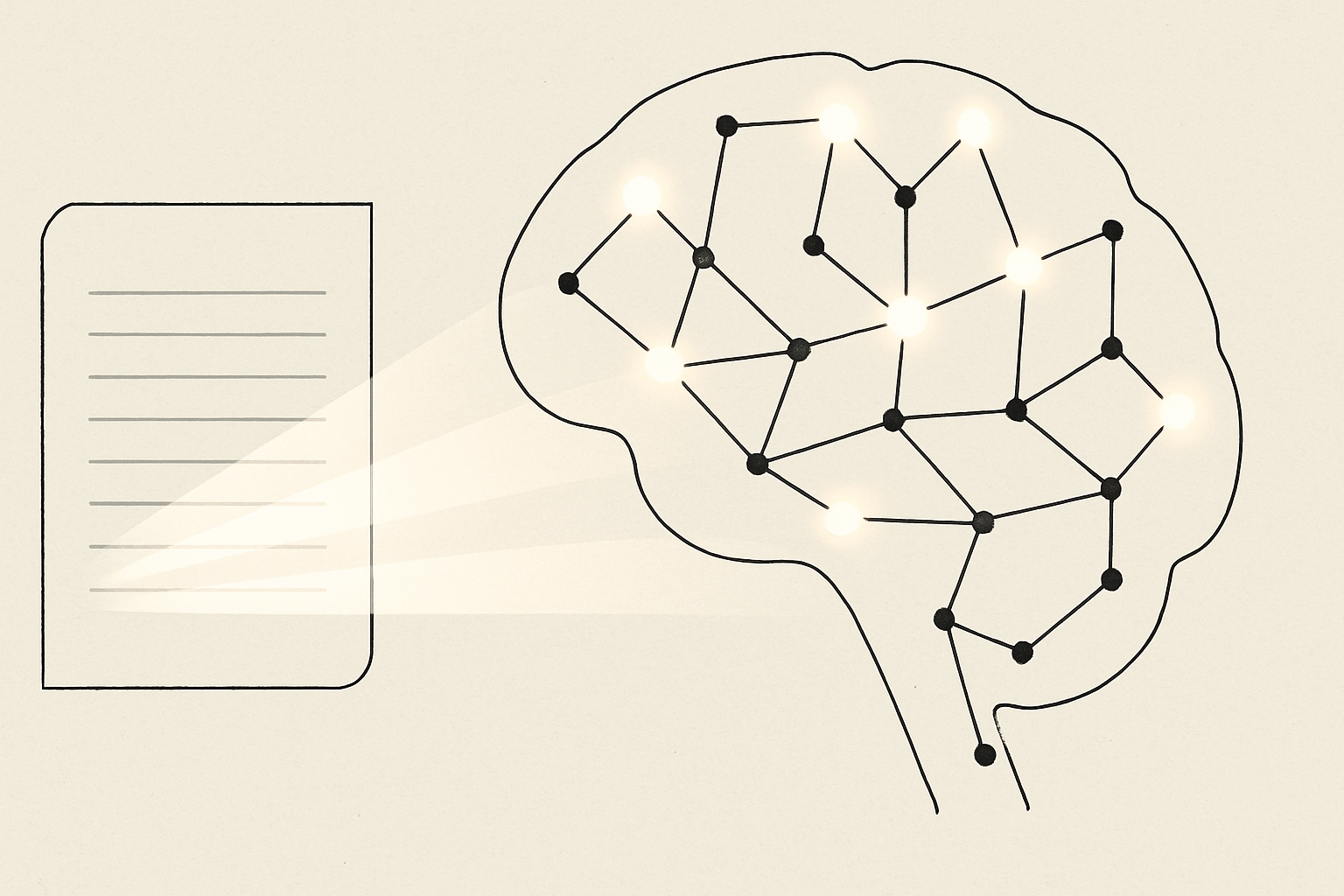
A small team I’ve been working with just shipped an alpha version of something I’m genuinely excited about — an AI generation engine that takes any PDF, ingests it, and builds you a custom AI around that content. Upload your documents, create a “project,” and you’ve got an AI that actually KNOWS your material. Not a chatbot pretending to know things. An AI grounded in your actual data.

It’s powered by OpenAI on the back end, with a clean user interface that makes the whole thing accessible to non-technical users. And the roadmap is obvious — PDFs today, any content type tomorrow.

But here’s the part that matters most: unlimited memory.

Why “Unlimited Memory” Is the Real Story

Most AI projects right now let you attach maybe a page or two of context to a conversation. That’s it. You hit the token limit and your AI starts forgetting things — or worse, hallucinating to fill in the gaps.

This engine connects to a vector database that can hold thousands of pages of content, all of it queryable by the AI when generating responses. I was talking about Pinecone and vector databases a few weeks back, and this is exactly the use case I was pointing at. The architecture that lets AI actually retain and retrieve large-scale knowledge isn’t theoretical anymore. It’s working.

For enterprise use cases especially, this is the unlock. Imagine loading in every policy document, every product spec, every customer interaction transcript — and having an AI that can draw on ALL of it when answering questions. That’s not a toy. That’s a business tool.

The Weird Part: AI Doesn’t Query Data the Way You’d Expect

Here’s where it gets interesting — and honestly, a bit humbling.

As we’ve been testing this engine, we hit a realization that I think is pretty important for anyone building on top of these tools. The AI does NOT pick data out of its attached vector database the way our human logic would expect. We went in assuming that if you structured your data clearly — nice Excel sheets, clean headings, logical organization — the AI would retrieve the right chunks when asked a question.

That’s.. not quite how it works.

You have to understand how the AI and the vector database interpret their tasks, and then how they query for suitable context to generate a response. The data needs to be structured for the MODEL, not for a human reader. An Excel sheet with perfectly human-readable data is not necessarily what works well for these tools.

Dimensionality Reduction and Why It Matters

This connects to a deeper concept that I think every AI builder needs to internalize.

Much of AI is about dimensionality reduction — the model can’t look at a billion variables to make a prediction, so it transforms the data into compressed representations. Think eigenvalues and eigenvectors if you want the math framing, but the key insight is simpler than that: the transformation of your data into something the AI can work with is where the magic happens. And that transformation doesn’t always preserve what a HUMAN would consider the most important features.

This means the way you chunk, format, and embed your source documents matters enormously. It’s not just “throw PDFs at a vector DB and hope for the best.” The ingestion pipeline — how you break content into chunks, how those chunks get embedded into vector space, how similarity search retrieves them at query time — that’s where the real engineering challenge lives.

I’ve been saying that knowledge ingestion is the killer app. I still believe that. But I’d refine it now: intelligent knowledge ingestion is the killer app. The teams that figure out how to transform human-readable content into AI-optimized knowledge representations are going to have a massive advantage.

What This Means for the AI Startup Landscape

If you’re building an AI product right now and you’re focused on the chat interface, the prompt engineering, the user experience — all of that matters, but I think you might be optimizing the wrong layer. The real defensibility is in the data pipeline.

How you ingest content. How you chunk it. How you embed it. How you retrieve it. That’s the stack that determines whether your AI actually delivers useful, grounded answers or just serves up confident-sounding nonsense.

We’re seeing this firsthand with our engine. The difference between a well-ingested document and a poorly-ingested one isn’t subtle — it’s the difference between an AI that feels like an expert and one that feels like it skimmed the Wikipedia summary.

The Takeaway

We’re still in alpha, and there’s a LOT of work ahead. But the core thesis is holding up: give an AI real knowledge — structured properly, stored in a vector database with unlimited capacity — and you get something qualitatively different from what most people are experiencing with ChatGPT today.

The next upgrade we’re working toward will make the retrieval smarter, not just bigger. Understanding how AI actually interprets and queries its knowledge store is the key to making these tools genuinely useful. Not just impressive demos — actually useful.

If you’re building in this space, stop thinking about data from a human perspective and start thinking about it from the model’s perspective. That mental shift is worth more than any prompt engineering trick I’ve seen.

Get my weekly AI dispatch

Real analysis from someone who's been building on the internet since 1996. Join 500+ founders and operators getting my take on AI, tools, and what's actually working.

Robertson Price

Robertson Price

Serial entrepreneur who has built and exited multiple internet companies over 25 years — from search (iWon.com, $750M acquisition) to content networks (32M monthly visitors) to e-commerce (Rebates.com). He now builds enterprise AI infrastructure at Ragu.AI.